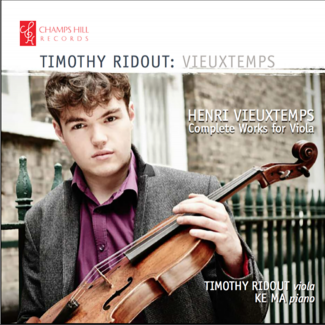
Timothy Ridout
Links
Download Assets
“So fluent, so confident, so glad to be alive.”
The Times, 2025
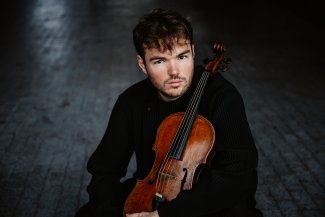
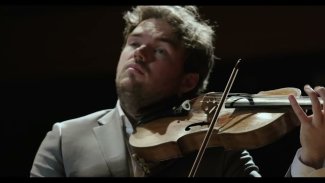
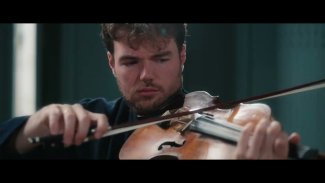
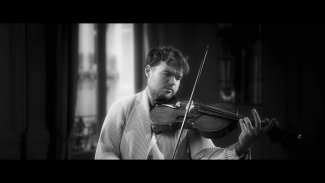
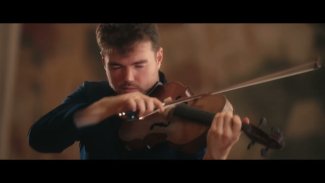
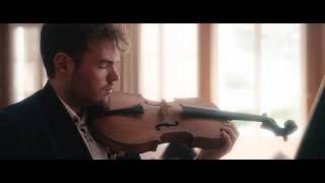
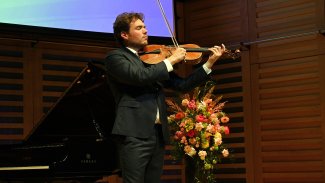
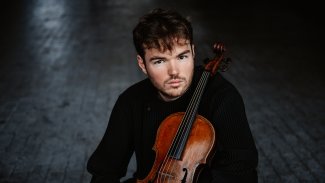
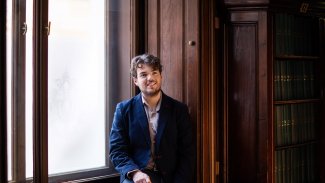
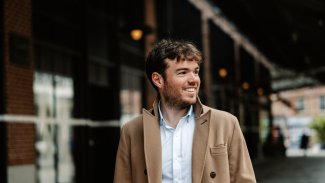
Described by The Guardian as a “rare kind of musician who could play a cardboard box and make it sing”, Timothy Ridout is internationally recognised for his distinctive musicality and compelling artistry.
Ridout appears regularly with leading orchestras including the Bavarian Radio Symphony Orchestra, hr-Sinfonieorchester, Dresden Philharmonie, Philharmonia Orchestra, Tonhalle-Orchester Zürich, Orchestre de Paris, Tokyo Metropolitan Symphony and Chamber Orchestra of Europe. He collaborates with distinguished conductors including Sir Simon Rattle, Sakari Oramo, Sir András Schiff, Sir Mark Elder, Hannu Lintu, Andrew Manze, Jonathan Darlington, Martyn Brabbins, Donald Runnicles, Sylvain Cambreling and Kazuki Yamada.
Concerto highlights of his 2026/27 season include Vaughan Williams’ Suite with Royal Scottish National Orchestra and Thomas Søndergård, Bacewicz’s Viola Concerto with Warsaw Philharmonic Orchestra and Norrlandsoperan Symphony Orchestra, Mozart Clarinet concerto with Symphoniker Hamburg, Hillborg’s Viola Concerto with Tapiola Sinfonietta, Kurtág’s Movement with Gulbenkian Orchestra, and Berlioz’s Harold in Italy with the Scottish Chamber Orchestra. Other concerto performances feature Mozart’s Sinfonia Concertante alongside Janine Jansen with the Royal Stockholm Philharmonic Orchestra under Ryan Bancroft and Lucerne Symphony Orchestra under Michael Sanderling.
See more
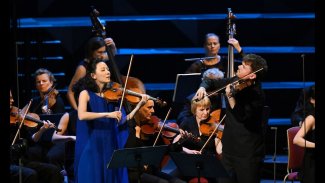
A passionate advocate of contemporary repertoire, Ridout gave the world premiere of Mark Simpson’s Viola Concerto Hold Your Heart in Your Teeth with the Deutsches Symphonie-Orchester Berlin and Robin Ticciati at the Berlin Philharmonie in 2024 and gave country premieres in Switzerland and the Netherlands last season. He has appeared twice at the BBC Proms together with BBC Symphony Orchestra and with Ensemble Resonanz.
This season he directs performances from the viola with Munich Chamber Orchestra at Wigmore Hall, the Academy of St Martin in the Fields, Kremerata Baltica and Manchester Camerata. As Artist in Residence with the De Valette Chamber Orchestra, he leads programmes in Valletta and Brussels.
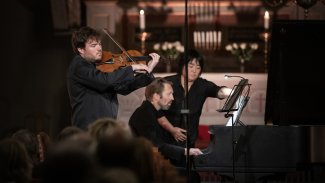
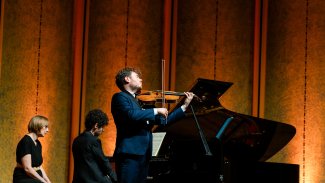
A highly respected chamber musician, Ridout performs in major venues including Wigmore Hall, Amsterdam’s Concertgebouw, Vienna’s Musikverein, Seoul Arts Center and New York’s Alice Tully Hall. He appears regularly at major international festivals such as Verbier, Salzburg, Mecklenburg-Vorpommern, Schleswig-Holstein Music Festival, Rheingau, Kissinger Sommer, Solsberg, Klosters, Evian, Beethoven Easter Festival and La Jolla. Forthcoming collaborations include projects with Benjamin Grosvenor, Kian Soltani, Hyeyoon Park, Federico Colli, Frank Dupree, Lucie Horsch, Martha Argerich, Mischa Maisky and Janine Jansen.
As an Associate Artist at Wigmore Hall, Ridout appears this season with Sol Gabetta, Hana Chang, Jonathan Ware, the Doric String Quartet, Adam Walker and Anneleen Lenaerts, and curates a day-long celebration of the viola showcasing the instrument’s remarkable versatility and breadth of repertoire. As a Junge Wilde artist at Dortmund’s Konzerthaus, he presents a solo recital, while further engagements include tours with the Chamber Music Society of Lincoln Center, and appearances at the Kaohsiung Festival in Taiwan, Viola Space in Japan and the Z+ Festival in Shanghai.
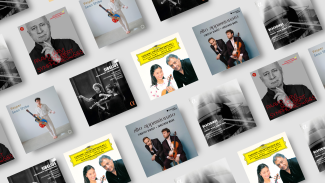
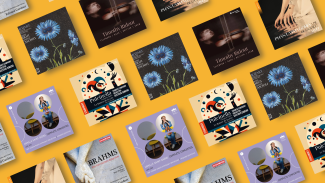
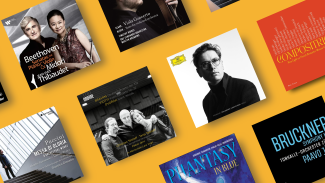
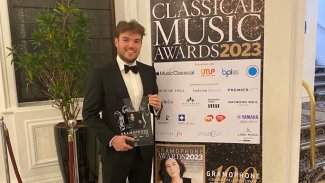
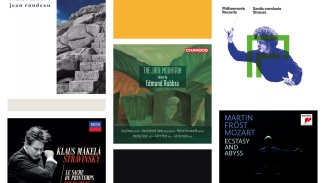
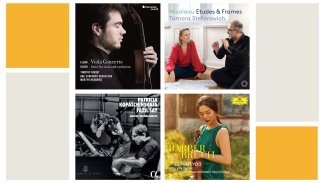
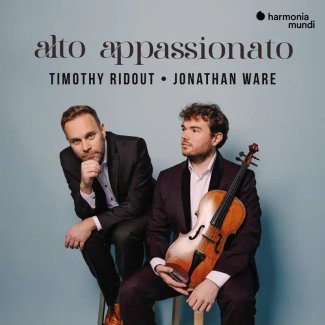
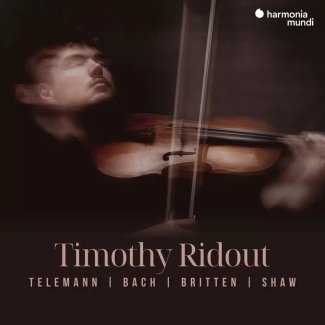
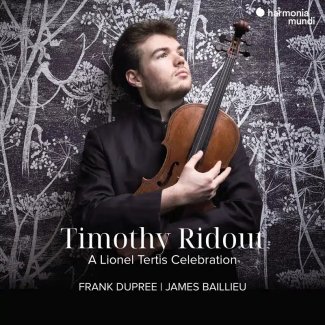
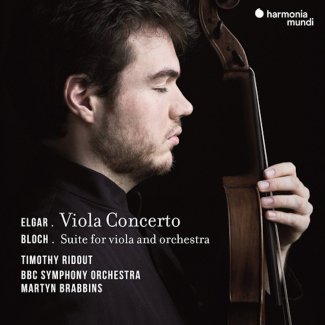
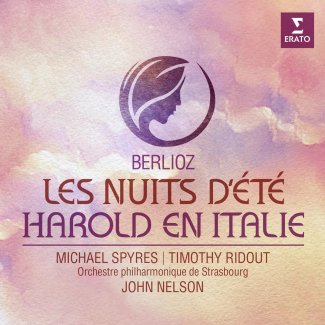
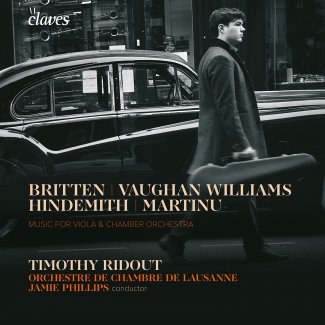
A recording artist of exceptional versatility, Ridout records exclusively for Harmonia Mundi. His latest album Alto Appassionato, recorded with pianist Jonathan Ware, explores the rich world of twentieth-century French music. Ridout received the BBC Music Magazine Instrumental Award (2026) and the Opus Klassik Young Instrumentalist of the Year Award (2025) for his solo album featuring works by Telemann, Bach, Britten and Caroline Shaw. In 2024 he released an album which paid tribute to the great violist Lionel Tertis. In 2023, he won a Gramophone Award for his recording of Elgar’s Cello Concerto, arranged for viola by Lionel Tertis, with BBC Symphony Orchestra and Martyn Brabbins. His extensive catalogue also includes recordings of works by Prokofiev, Britten, Schumann, Vaughan Williams, Hindemith and Martinů, in collaboration with the Orchestre Philharmonique de Strasbourg, Orchestre de Chambre de Lausanne, and pianists Frank Dupree and James Baillieu.
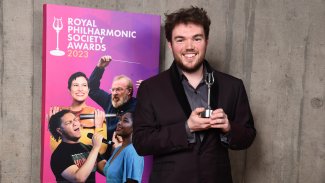
A graduate of the Royal Academy of Music and Kronberg Academy, Ridout is the recipient of numerous international honours, including First Prize at both the Lionel Tertis and Cecil Aronowitz International Viola Competitions. A former BBC New Generation Artist and Borletti-Buitoni Trust Fellow, he received the Royal Philharmonic Society’s Young Artist Award in 2023 and was the inaugural recipient of the Hamburg Symphony Orchestra’s Sir Jeffrey Tate Prize. He is also an alumnus of the Chamber Music Society of Lincoln Center’s prestigious Bowers Program.
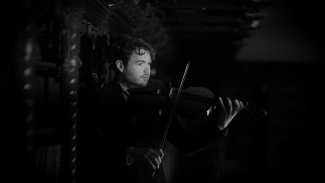
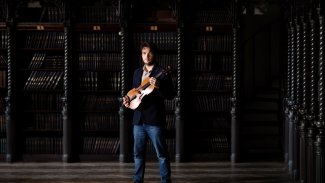
Timothy Ridout performs on a viola by Peregrino di Zanetto (c.1565 – 1575), generously loaned by a patron of the Beare’s International Violin Society.
Contacts
Dáire Ní Chonaill Associate Artist Relations Manager
worldwide general management
Dáire Ní Chonaill Associate Artist Relations Manager
worldwide general management
“The fullness and beauty of his tone brought out all the mellow strengths of the instrument, and his refined sense of musical phrasing puts him in the top rank of performers on any instrument.”
“Ridout was in total command from the start, opening with long phrases and outbursts of discordant double-stopping…there was a meaty boldness and even a certain chutzpah to his approach; his playing was technically adroit and featured richly burnished tone”
“The technical challenges are formidable, especially in the third movement, but Ridout met them with ease.”
“Ridout’s taut, passionate playing drew out every note, yet his crying solo, as if from a distance, at the opening of the finale was achingly impressive”
“Ridout lavishes as much loving care upon Telemann’s miniatures as on J.S. Bach’s monumental violin masterpiece. Sticking mostly to low positions and with generous use of open strings, he brings out the music’s latent polyphony, while sprightly rhythms and a keen ear for embellishments underline its omnipresent dance-like character.”
“Ridout is a truly extraordinary soloist, extracting a glorious sound from a 1575 viola built by Peregrino di Zanetto, with which he literally merges.”
“So fluent, so confident, so glad to be alive”
“A skilled and thoughtful player, he artfully captures the myriad colours and moods of this once-misunderstood instrument.”
“A lovingly curated tribute to one of the past’s finest viola players, Lionel Tertis, from one of today’s, Timothy Ridout: a generously filled album of glorious music.”
“Anyone who enjoys fine string playing shouldn’t hesitate to sample these performances.”
“This is a magisterial performance in anyone’s book.”
“As prodigious in Berlioz as in Elgar and Bloch […] amazing technical mastery, eloquence and lyricism […] The warmth, maturity and intense expressiveness are marvellous.”
“Ridout scores here with his brilliantly nimble fingerwork and precise note-separation. His slow movement is heartfelt, and the finale crackles with insightful, immaculately executed solo playing.”
“Ridout makes the scherzo fabulously nimble and precise, and the long aching lines of the Adagio even more plangent.”
“[Timothy Ridout] has a knack for playing almost unplayable scores with a disarming naturalness.”
“With just a few strokes of his bow, the British Timothy Ridout has made a place for himself in the very closed circle of great violists. His youthful brilliance […], his impatient assurance, and above all the natural authority of a style of playing that is both totally free and accomplished, kept the audience in the Salle Cortot, in Paris, in suspense”
“Undoubted star of the second half was violist Timothy Ridout, whose performance of Britten’s Lachrymae, mercurial yet autumnally intoxicating, was strengthened by prefacing it with Manze’s own arrangement of the Dowland song, “If my complaints could passions move”, on which the Britten is based.”
“The singers of the [Scottish Chamber Orchestra] Chorus got the tone just right, by turns rich, alluring or ardent; and Timothy Ridout’s viola surged in and out of the texture in a way that brought it to life without drawing attention to himself.”
“Timothy Ridout gave a performance of exceptional eloquence and maturity, and Downie Dear ensured that the players, both in their accompaniment and in the expansive orchestral sections, matched Ridout in sensitivity. The sheer beauty of it all was mesmerising and, by the end, profoundly moving.”
“Ridout’s transcription makes telling changes of register in the vocal line; this is supreme vindication of what musical imagination can do, even to works unfamiliar from their original formats.”
“In Tempo primo it was the viola’s turn. Timothy Ridout stood out with a deeply emotional and romantic sound. Perhaps this movement was the best of the concert. Delicate, romantic … ”
“I confess to having capitulated unconditionally to this heartfelt rendition of Schumann’s masterful song cycle on the viola. Ridout varies his sound astutely on repeated verses, bringing forth from his Peregrino Di Zanetto instrument myriad colours that bear testimony to his profound love of this music.”
“Timothy Ridout proved the ideal interpreter. Youthful and technically pitch perfect, he was also able to bring a sensitivity to his interpretation that emphasised a sense of fragility in the work that can sometimes be missed.”
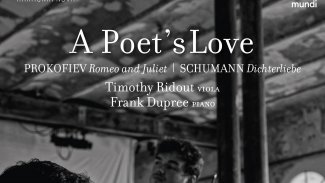
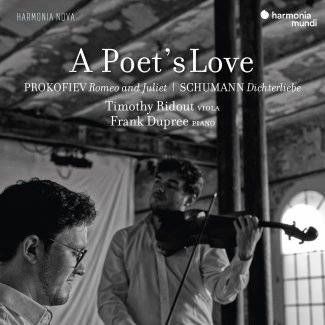
A Poet’s Love (Harmonia Mundi)
“Ridout has made his own, highly effective arrangement of Schumann’s song cycle from 1840, Dichterliebe (A Poet’s Love). At times he uses the viola’s flowing, higher register. Yet in a song such as Im Rhein, im heiligen Strome, with its grand aural depiction of Cologne Cathedral, he exploits the instrument’s baritonal qualities, always making the viola sing.”
A Poet’s Love (Harmonia Mundi)
“It is absolutely magnificent how Ridout’s viola transforms chameleon-like to fit the character of each number from Prokofiev’s ballet. It shows how confident he plays and how wide his color palette is… Detached from the text, one experiences Dichterliebe in a performance that is probably hard to beat for richness of nuance. And, believe me, one holds one’s breath again and again, so deeply emotional, so gripping is the performance. This fine work, this art of tasteful nuance and of communicating the depth of one’s own experience, results in a superior interpretation of Schumann’s music.”
“The irregular rhythms of Martinů’s Rhapsody-Concerto sound completely natural in Ridout’s hands as he alternates between unobstructive technical brilliance in the fast sections and a disarmingly gorgeous singing tone in the piece’s concluding moments.”
‘There was a persuasive sense of journeying towards a clear ‘end’: and, in the closing moments the frenetic alternation of arpeggiation and chordal outbursts cleared into a pizzicato conclusion of striking beauty and resonance.’
“The young violist Timothy Ridout plays four striking works with viola. In his the mid-twenties, he is already the recipient of many awards. It is therefore not surprising that he not only performs with a sophisticated technique, but presents a very personal interpretation.”
“You don’t even have to hear Timothy Ridout. You can see what he has to say with his instrument […]”
“[…] a performer whose touch could not be surer and whose musical instinct inspires confidence on every level, all conveyed through 24-carat dark-gold tone. Ridout won the Lionel Tertis Viola Competition a few years back and I think Tertis himself would be proud.“
“Violist Timothy Ridout shines with virtuosity.”
“Master virtuoso.”
“Top performances were in abundance… Amongst the standouts was Timothy Ridout’s transfixing rendition of Britten’s Lachrymae. Closing a concert intended as an elegy to Benjamin Britten on the very date of the composer’s 100th birthday, the young British violist soared to new heights in a rendition that brought many to tears, a virtual recreation of the Dowland text, ‘Flow my tears’.”
“I was strongly impressed by the gorgeous singing tone that Timothy Ridout produced. Furthermore, he was soulful and sensitive in his delivery of the music… I greatly admired Timothy Ridout’s performance of this great concerto [Walton]… He was able to deliver when virtuosity was required, but what will live longest in my memory was his wonderful response to the many ardently lyrical passages.”
“…Ridout tilting Walton’s final chord from minor to major in such an understated way that it became the most modest of triumphs.”
“This disc contains some of the best music written for the viola in the 19th Century… [Ridout] is a fine, young violist with a solid tone, perfect intonation, solid technique, and charisma. I look forward to hearing more from him.”
“A gorgeous tone, a thoughtful approach to phrasing and an infectious sense of impetuosity.”
“Ridout displays a consistently imaginative ear for tonal colours and an exciting variety of vibrato … clearly a talent to follow.”
“Timothy Ridout, with his technical perfection and beautifully warm and soft tone, perfectly matched the Romantic yearning [of Cecil Forsyth’s Viola Concerto in G minor].”