Siyabonga Maqungo
Download Assets
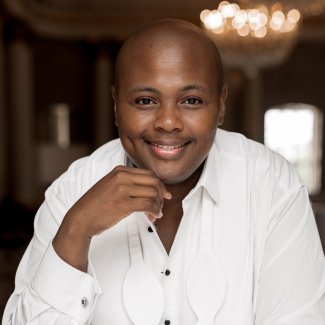
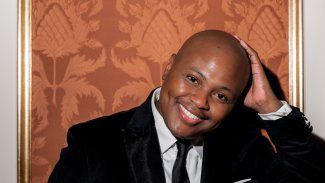
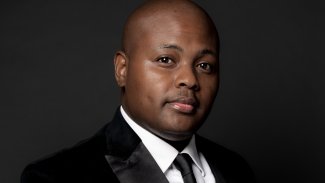
South African tenor Siyabonga Maqungo is celebrated for his luminous vocal colour, emotional honesty, and charming stage presence. Whether portraying a bright-eyed David in Wagner’s Die Meistersinger von Nürnberg or Rossini’s elegant Count Almaviva in Il barbieredi Siviglia, Maqungo’s sincerity and warmth consistently resonate with audiences.
In recent seasons, Maqungo has established himself as one of the leading lyrical tenors of the Staatsoper Unter den Linden ensemble of which he has been a member since the 2020/2021 season. He has appeared in a wide-ranging repertoire that includes Tamino in Die Zauberflöte, Jaquino in Fidelio, Froh in Das Rheingold, David, Count Almaviva, and new roles such as Belmonte in Andrea Moses’ new production of Die Entführung aus dem Serail, under Thomas Guggeis, and Henry Morosus in Die schweigsame Frau, marking the inauguration of Christian Thielemann’s tenure as Music Director.
In the 2026/27 season at Staatsoper Unter den Linden, Maqungo takes on the role of Cinna in La Vestale, reprises his Tamino, and sings Walther in Tannhäuser under Thielemann. He debuts at Salzburg Mozartwoche as Ferrando in Così fan tutte with Camerata Salzburg under Ivor Bolton and joins Vladimir Jurowski and Rundfunk-Sinfonieorchester Berlin as Leukipposin a concert performance of Strauss’s Daphne.
See More
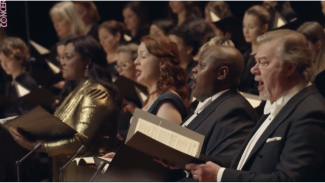
Renowned for his concert work, highlights of the current season include performances of Beethoven, Symphony No. 9 with the Chicago Symphony Orchestra under Klaus Mäkelä, at Teatro alla Scala under Myung-Whun Chung, and with Orchestre Philharmonique de Strasbourg under Aziz Shokhakimov. He sings Mendelssohn, Lobgesang with Gothenburg Symphony Orchestra under Samy Rachid, Mozart, Requiem with Deutsches Symphonie-Orchester Berlin under Jeannette Sorrell, and Beethoven, Der glorreiche Augenblick with Orchestra e Coro dell’Accademia Nazionale di Santa Cecilia under Riccardo Minasi. Marking his London debut, he joins Edward Gardner and the London Philharmonic Orchestra in Schumann, Das Paradies und die Peri, and he sings Beethoven, Missa Solemnis at Bergen International Festival, conducted by Thomas Guggeis.
Siyabonga Maqungo’s growing international opera career has, in recent seasons, brought his debut at Teatro alla Scala as Froh in David McVicar’s new staging of Das Rheingold under Simone Young, as well as the title role in Mitridate, re di Ponto at Teatro Real, conducted by Ivor Bolton in Claus Guth’s production. He joined Freiburg Barockorchester and René Jacobs on a major European tour of Cavalli, Il Giustino and debuted at Bayreuther Festspiele as Froh under Christian Thielemann.
Increasingly in demand on the concert platform, Maqungo has recently appeared with Münchener Philharmoniker under Riccardo Minasi in Michael Haydn, Requiem and with Orchestre Philharmonique de Strasbourg and Aziz Shokhakimov in Puccini, Messa di Gloria. In Beethoven, Symphony No.9, he has performed with Orchestre de Paris and Klaus Mäkelä, Orchestra e Coro dell’Accademia Nazionale di Santa Cecilia and Lahav Shani, Atlanta Symphony Orchestra and Nathalie Stutzmann and Yomiuri Nippon Symphony Orchestra and Maxime Pascal.
His discography includes a standout performance as Pong in Puccini, Turandot, conducted by Sir Antonio Pappano, released by Warner Classics and nominated for the 2023 International Opera Award.
Siyabonga Maqungo was born and raised in South Africa and began his musical studies at North-West University and continued at the Hochschule für Musik und Tanz Köln with Josef Protschka. He was awarded second prize at the 2018 Portofino International Opera Competition, followed by a Young Singer nomination at the 2019 International Opera Awards.
Contacts
General Management
General Management
“Siyabonga Maqungo — a joyful singer with a very beautiful tone”
“Tenor Siyabonga Maqungo…makes it clear with his delicate, tender voice what the term “lyrical tenor” means.”
“Siyabonga Maqungo sang Belmonte with a warm, unmistakably Mozartian tenor, his lyrical phrasing lending credibility to the young nobleman’s devotion.”
“Even more impressive is the performance of South African tenor Siyabonga Maqungo …his luminous, wonderfully individual timbred tenor, which blossoms even more golden in the high register and is impeccably focused, is among the best that the young generation of opera singers has produced. He elevates every opera performance he participates in, not least with his genuine commitment.”
“As the antagonist Vitaliano, Siyabonga Maqungo commanded the stage with a formidable & chiselled vocal presence. He expertly balanced the cruelty of his character — evident in his chilling treatment of Arianna — with a final, dignified recognition of his kinship to Gustino.”
“…Siyabonga Maqungo as Vitaliano stood out for the brilliance of his tenor voice”
“To the other ruler figure, Vitaliano, Siyabonga Maqungo gives his elegant, highly sensitive tenor, which brings out the ambivalence of this role (from ‘evil’ to ‘good’) with subtle nuances.”
“Siyabonga Maqungo gave life to Vitaliano, a general initially antagonistic to Anastasio, who evolves towards reconciliation, with a performance of great technical ability, especially in the passages demanding agility, handled with precision despite the demands of the lower tessitura.”
“Siyabonga Maqungo’s Froh was splendid and luminous, with remarkable freshness of timbre.”
“Maqungo had the joy of performing what may well be the only truly delightful tenor role Strauss ever composed. The South African singer seized the opportunity with gusto, wrapping this splendid character in his caressing, impassioned voice and rendering him more endearing than ever.”
“As Henry, Siyabonga Maqungo displayed an easy, full tenor that soared above the orchestra – and other soloists. At the head of the group of actors, Maqungo had the most fun on stage, changing costume and personality in a wink.”
“Here is a Mozartian tenor like we rarely hear, of admirable poetry and delicacy, with an ability to nuance dynamics and colors as we dream of.”
“Maqungo mastered the trills and coloratura that darker-voiced tenors often struggle with. His angry aria […] at the end of the first act was a joy to hear.”
“South African tenor Siyabonga Maqungo’s Walther von der Vogelweide exalts Tannhäuser’s sacrifice of sensuality in a clear and luminous light.”
“Siyabonga Maqungo’s Walther von der Vogelweide stands out because of its auspicious, characteristically silvery glowing sound.”