Deepa Johnny
Links
Download Assets
“Deepa Johnny was the real deal: a striking freshness and beauty of tone allied to a real sense of ease through the coloratura”
– Opera Magazine, November 2025
Omani-born mezzo-soprano Deepa Johnny has rapidly established herself as one of the most compelling artists of her generation, captivating audiences on the international opera stage with a voice of remarkable richness, musical intelligence, and a striking stage presence. In the formative seasons of her career, she has already demonstrated exceptional versatility in a repertoire spanning roles by Monteverdi, Mozart, Rossini, and Bizet through complex contemporary works with equal distinction. Acclaimed by critics and audiences alike, Deepa has marked herself out as a singular talent set for a glittering international presence.
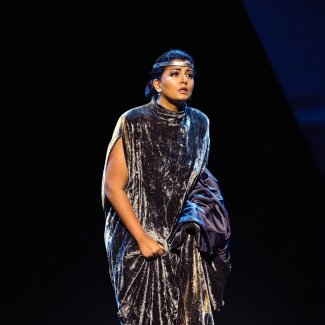
Johnny first captured attention with a magnetic portrayal of Carmen in Romain Gilbert’s production at Opéra de Rouen Normandie, a performance that critics heralded “a revelation”, soon deepening that impression with a poignant and compelling Penelope in Il ritorno d’Ulisse in Patria at Festival d’Aix-en-Provence, under the baton of Leonardo García Alarcón and in one of the final visionary stagings by Pierre Audi.
See more
A series of further high-profile debuts confirmed her as one of today’s most compelling young artists. At the Canadian Opera Company, her sparkling Rosina in Il barbiere di Siviglia earned praise as the “standout performance of the evening” (The Globe and Mail), while at Opéra national de Paris, she revealed remarkable dramatic range in two strikingly contrasting roles: as Kasturbai in Phillip Glass’ Satyagraha, conducted by Ingo Metzmacher, and as Dejanire in Antonia Bembo’s Ercole Amante, in Netia Jones’ staging and under the direction of Leonardo García Alarcón.
Johnny’s operatic journey continues to encompass an impressive breadth of repertoire and stages, from Rosina at Opéra de Lille and Dorabella in Così fan tutte at Opéra national de Lyon to Angelina in La Cenerentola at English National Opera and Houston Grand Opera to Cherubino in Le Nozze di Figaro with both Portland Opera and Opera San Jose. Beyond the traditional operatic canon, she has embraced boundary-pushing contemporary work, joining the inaugural cast of The Faggots and Their Friends Between Revolutions, Ted Huffman and Philip Venables’ bold adaptation of Larry Mitchell’s seminal LGBTQ+ text. The production’s international journey took her to Manchester International Festival, Festival d’Aix-en-Provence, Bregenzer Festspiele and to London’s Southbank Centre.
The 2026/2027 season for Deepa Johnny includes her debut at Glyndebourne Festival Opera as Idamante in a new production of Idomeneo by Stephen Langridge, conducted by Robin Ticciati before returning to one of her signature roles, Rosina, at Vancouver Opera under Leslie Dala. On the concert platform, she appears for the first time with Toronto Symphony Orchestra in Händel’s Messiah, led by Ivor Bolton and joins a select group of artists showcased in recital at New York’s Park Avenue Armory. Accompanied by pianist Jonathan Ware, they explore a richly coloured programme spanning Bizet, Ravel, Lorca, Gershwin and Bernstein.
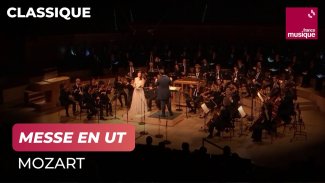
On the concert stage, Deepa Johnny has performed in some of the world’s most celebrated venues, appearing with the Los Angeles Philharmonic Orchestra and Gustavo Dudamel in Mendelssohn, A Midsummer Night’s Dream at both Disney Hall and Carnegie Hall. She also performed Mozart, Mass in C minor with l’Orchestre Philharmonique de Radio France under García Alarcón and Handel, Messiah with Winnipeg Symphony Orchestra and Mathieu Lussier. Equally at home in the intimate setting of song recital, Johnny featured together with pianist Alphonse Cémin in the 2024 Festival d’Aix-en-Provence, was selected as a fellow of the prestigious Ravinia Steans Vocal Institute, and took part in Renée Fleming’s SongStudio at Carnegie Hall.
Deepa Johnny is a graduate of Indiana University and LA Opera’s Domingo-Colburn Stein’s Young Artist Program. Early performances included creating the role of Owen’s daughter in Omar, a world-premiere by Rhiannon Giddens and Michael Abels and appearing as Mélisande in Impressions de Pelléas at LAO, singing Meg Page to Bryn Terfel’s Falstaff at Aspen Music Festival and the title roles of both Xerxes and L’incoronazione di Poppea at IU Opera Theater.A series of further high-profile debuts confirmed her as one of today’s most compelling young artists. At the Canadian Opera Company, her sparkling Rosina in Il barbiere di Siviglia earned praise as the “standout performance of the evening” (The Globe and Mail), while at Opéra national de Paris, she revealed remarkable dramatic range in two strikingly contrasting roles: as Kasturbai in Phillip Glass’ Satyagraha, conducted by Ingo Metzmacher, and as Dejanire in Antonia Bembo’s Ercole Amante, in Netia Jones’ staging and under the direction of Leonardo García Alarcón.
Johnny’s operatic journey continues to encompass an impressive breadth of repertoire and stages, from Rosina at Opéra de Lille and Dorabella in Così fan tutte at Opéra national de Lyon to Angelina in La Cenerentola at English National Opera and Houston Grand Opera to Cherubino in Le Nozze di Figaro with both Portland Opera and Opera San Jose. Beyond the traditional operatic canon, she has embraced boundary-pushing contemporary work, joining the inaugural cast of The Faggots and Their Friends Between Revolutions, Ted Huffman and Philip Venables’ bold adaptation of Larry Mitchell’s seminal LGBTQ+ text. The production’s international journey took her to Manchester International Festival, Festival d’Aix-en-Provence, Bregenzer Festspiele and to London’s Southbank Centre.
The 2026/2027 season for Deepa Johnny includes her debut at Glyndebourne Festival Opera as Idamante in a new production of Idomeneo by Stephen Langridge, conducted by Robin Ticciati before returning to one of her signature roles, Rosina, at Vancouver Opera under Leslie Dala. On the concert platform, she appears for the first time with Toronto Symphony Orchestra in Händel’s Messiah, led by Ivor Bolton and joins a select group of artists showcased in recital at New York’s Park Avenue Armory. Accompanied by pianist Jonathan Ware, they explore a richly coloured programme spanning Bizet, Ravel, Lorca, Gershwin and Bernstein.
On the concert stage, Deepa Johnny has performed in some of the world’s most celebrated venues, appearing with the Los Angeles Philharmonic Orchestra and Gustavo Dudamel in Mendelssohn, A Midsummer Night’s Dream at both Disney Hall and Carnegie Hall. She also performed Mozart, Mass in C minor with l’Orchestre Philharmonique de Radio France under García Alarcón and Handel, Messiah with Winnipeg Symphony Orchestra and Mathieu Lussier. Equally at home in the intimate setting of song recital, Johnny featured together with pianist Alphonse Cémin in the 2024 Festival d’Aix-en-Provence, was selected as a fellow of the prestigious Ravinia Steans Vocal Institute, and took part in Renée Fleming’s SongStudio at Carnegie Hall.
Deepa Johnny is a graduate of Indiana University and LA Opera’s Domingo-Colburn Stein’s Young Artist Program. Early performances included creating the role of Owen’s daughter in Omar, a world-premiere by Rhiannon Giddens and Michael Abels and appearing as Mélisande in Impressions de Pelléas at LAO, singing Meg Page to Bryn Terfel’s Falstaff at Aspen Music Festival and the title roles of both Xerxes and L’incoronazione di Poppea at IU Opera Theater.
Contacts
Peppie Johnson Associate Artist Manager, VOICE
General Management
Peppie Johnson Associate Artist Manager, VOICE
Peppie Johnson Associate Artist Manager, VOICE
General Management
Gallery
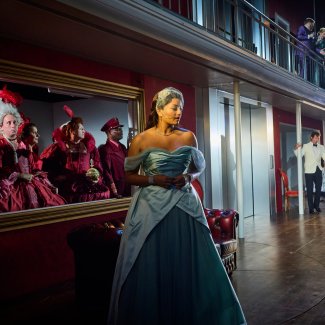
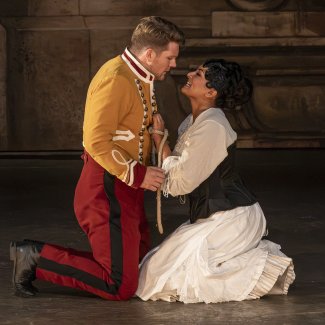
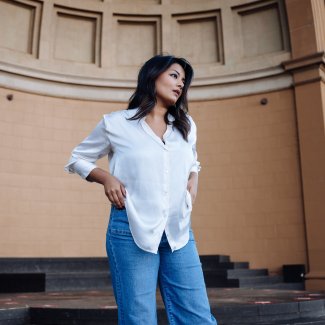
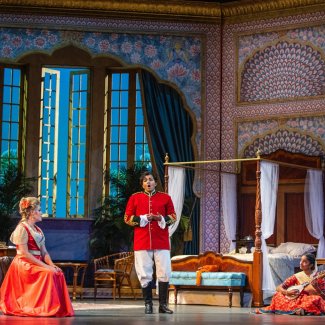
“Special praise is due to Deepa Johnny for her accomplished Dejanira”
“Deepa Johnny gives Dejanira the most moving moment of the evening.”
“Mezzo-soprano Deepa Johnny, with her velvety tone and natural ease, brings a touching tenderness to her Act III lament”
“The mezzo-soprano Deepa Johnny displays an agile vibrato that lends both softness and intimacy to her warm voice.”
“Deepa Johnny delivers a flawless performance.”
“Mezzo-soprano Johnny offers the standout performance of the evening as Rosina, the whip-smart ingenue whose music offers an inside look at her innermost thoughts. Johnny seamlessly manoeuvres her voice to fit the wide musical demands of any given scene, and throughout The Barber of Seville shows off shimmery, delicate high notes, as well as meatier passages at the bottom end of her vocal register”
“Deepa’s voice is clear, bright and beautifully controlled and she navigates florid runs with ease. She’s also a very appealing actor with good stage presence.”
“But the production’s strongest performance belongs to Canadian mezzo-soprano Deepa Johnny as Rosina. She makes the tricky aria “Una voce poco fa” sound easy, her voice shimmering as she traverses the song’s coloratura runs and melodic leaps”
“Singing the title role, the mezzo Deepa Johnny was the real deal: a striking freshness and beauty of tone allied to a real sense of ease through the coloratura”
“Deepa Johnny is a beguiling Cinderella, admirably clear-toned, precise in the fast runs”
“A star is needed for the title role and ENO has found one in Deepa Johnny. She has an attractive voice with impressive coloratura, moves naturally and won all hearts.”
“Deepa Johnny is blessed with the kind of honeyed timbre you could melt inside and she lent tremendous class and skill to the title role.”
“Deepa Johnny seemed to breathe coloratura, producing cascades of notes with her light, luminous mezzo as if nothing could be easier.”
“Deepa Johnny (Dorabella) once again offers the audience her amber-hued, radiant voice, capturing the nuances of the role with youthful spontaneity.”
“Deepa Johnny is a top-tier Dorabella who steals the spotlight from Fiordiligi. The Canadian mezzo-soprano shows a striking ability tonight to sing and act in an exceptionally modern way. Deepa Johnny portrays a Dorabella who is tormented and shaken in her convictions. This depth clearly comes through in her vocal interpretation, particularly in the aria “Smanie implacabili,” which she delivers masterfully, with no technical errors or lapses in taste.”
“The Canadian Deepa Johnny is a very accomplished Rosina, with a full, smooth voice, and an immediate warmth of character.”
“Rosina, portrayed by Deepa Johnny, masters the coloratura and vocal feats demanded by Rossini’s score. Una Voce poco fa is dazzling in its virtuosity, and Johnny achieves the remarkable feat of delivering an almost nonchalant interpretation while playing the young ingénue recounting her passions. The singer was met with resounding applause.”
“Deepa Johnny is a near-perfect Rosina. Her playful stage presence, warm tone, and expressive diction all contribute to her portrayal of a Rosina full of energy and character, especially with her flawless command of the bel canto technique.”
“Vocally and dramatically, the star is mezzo-soprano Deepa Johnny in the title-role. From her first entrance and in every note of the Habanera, she is determined to maintain her dignity. She is sultry when necessary, and her seduction of Don José is fully convincing. But there is an ethical refusal of the hyper-sexualised interpretation of Carmen in Johnny’s performance that, paradoxically, makes her an even more alluring and sympathetic figure.”
“The elegant Deepa Johnny (Penelope) brought gorgeous, rich tone and expressive words and features.”
“Deepa Johnny, the Omani mezzo-soprano, embodies Penelope with a dignity that suggests Ulysses is in her very soul. Her long, bittersweet notes convey a restrained fury, both in her straight-tone singing and narration. Occasionally, she steps away from her regal demeanor, her queenly, statue-like presence, to share a few intimate confessions from the edge of her lips. She weaves her singing like a loom, alternating between velvet and coarse fabric, using lingering vowels that leave traces like venom.”
“From the outset, Deepa Johnny presents a Penelope that is deeply moving and totally convincing.”
“Mezzo Deepa Johnny appears as the very incarnation of Penelope, draped in an elegant bronze costume. She is as comfortable in this role as she was in her Carmen which brought her to attention not long ago. Her presence on stage gives off an aura that her warm, coppery voice asserts with ease. From her first scene, she fascinates the audience with the aria: “I am a mortal thing” which she sings detached and worried. Each of her appearances on stage creates a presence comparable to that of the famous tragedienne Irène Papas. Her final duet with Ulysses finally sees her lay down her arms and devote herself completely to the return of happiness, in heady melismas.”
“The formidable and sensual Carmen by Deepa Johnny, a young Canadian mezzo-soprano of Omani origin, caused a sensation on Friday at the premiere”
“Deepa Johnny’s stage presence is admirable; the overflowing sensuality, the wide vocal range with an easy top and well-rounded bottom, as well as her rich timbre”
“Deepa Johnny is a revelation. It’s hard to believe she is not French-speaking as the French is crystal clear. The colour of the voice is superb, with a powerful low register and controlled top notes. She takes to the stage with fervour and confidence.”
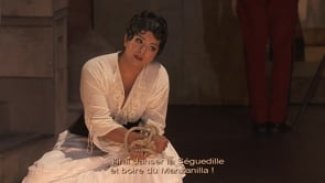
“Deepa Johnny is Carmen. The Canadian artist has an ease on stage … the warm colour of her voice is ideally suited to the role and her French diction is worthy of any native-French Carmen …. in the séguedille, Deepa Johnny reveals a meticulous line, perfectly held high notes and scrupulously controlled breath”
“The young Omani-born Canadian offers an undeniable stage presence. Demonstrating virtuosity, a wide dynamic range and an expressive timbre, her voice can be sinuous, seductive and scathing like a slap. The audience gives her Carmen a standing ovation.”
“Deepa Johnny’s tone is velvet when she’s singing [..]. The vocal line is generous and dense, soft with a small natural vibrato, […] while the breath flows from the bottom of the lungs to the top of the larynx, legato and supported.”
“ ‘Venables’ score is at its most patient showcasing the vocal beauty of Deepa Johnny”
“Mezzo-soprano Deepa Johnny was a mesmerizing figure as the sex-addled teenager Cherubino, matching her buoyant singing with a stage demeanor that spoke eloquently of hormonal confusion.”
“This exceptionally strong ensemble had one other delicious standout in Deepa Johnny who is a new member of our young artist program. Her showcase aria in the second act compares Omar’s writing on the walls of his jail cell to birds flying through the sky. She brought a lovely, bright, flutey mezzo soprano to the piece and her youthful joy was credible and sweet.”
“Deepa Johnny excelled in her role debut as the page Cherubino both in the ease of delivery of her delicate instrument and in her complete transformation for the trouser role. She had a great comic timing as well, and the audience loved her cross-dressing antics!”
“The alluring, rich-voiced mezzo-soprano Deepa Johnny introduced me and I suspect others, to the songs of Alberto Hemsi…Her performance of three of his songs revealed a deep connection to this colourful, exotic music which she performed with such flare.”
“Mezzo Deepa Johnny makes the arc of Carmen’s story her energy, her lovers and her final death at the hands of Don Jose a compelling tale.”